By RJ Lino, former president director of PT Pelindo II.
There is a deeper truth behind how a nation moves its goods. At its core, logistics is about energy — how it is consumed, how it is distributed, and how often it is quietly wasted. In Indonesia today, this truth explains much of what we continue to experience: high logistics costs, persistent regional price disparities, industrial concentration, and a system that improves in fragments but never quite transforms as a whole.
The Hidden Cost of Movement
Logistics is rarely discussed in the language of energy. However, it is one of its largest invisible consumers. Every truck moving along Java’s highways carries more than cargo. It also carries fuel consumption across long distances. Every delay in congestion does not only waste time; it multiplies energy use. Over time, the system begins to absorb energy rather than efficiently translate it into movement.
This is where a fundamental misunderstanding begins. Logistics is not an equation of oil. Transport cost is. Logistics, in its essence, is an equation of reliability.
When reliability weakens, inventory rises. When inventory rises, capital becomes trapped. And when capital is trapped, the economy quietly bears the cost — often in ways that are not immediately visible in freight tariffs, but deeply embedded in prices, competitiveness, and growth. This is why looking only at transport tariffs understates the problem considerably. The deeper cost is what companies spend compensating for a system they can't count on.
A Maritime Nation Thinking Like a Continent
Indonesia is, by nature, an archipelago. Yet we have designed our logistics system as if we were a continental economy — one where distance must primarily be conquered by land.
Road transport dominates even across corridors where maritime transport should naturally prevail. This is not simply an operational preference. It reflects a deeper structural misreading of geography.
In a maritime nation, the sea isn't distance — it's connectivity. Indonesia is, in many ways, a natural Roll-on/Roll-off (RoRo) country. Much of its inter-island movement happens within short-sea distances of under 48 hours, and the geography strongly favors that kind of rolling, distributed freight over dependence on long-haul trucking. Instead, cargo has increasingly moved onto roads, at significant energy and infrastructure cost. The result is a maritime nation running on the logistics logic of a landlocked one.
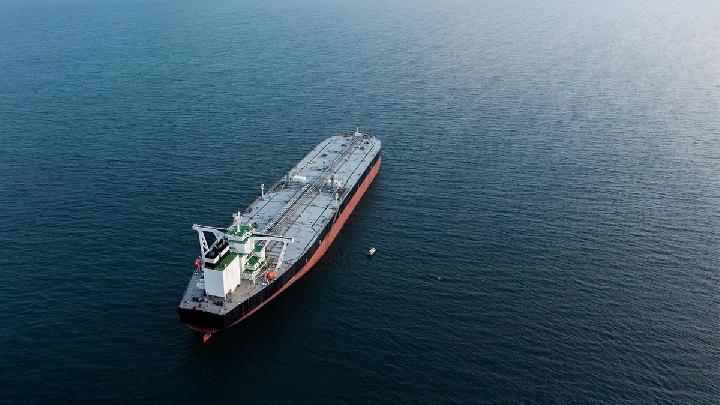
At sea, the economic logic shifts — scale replaces fragmentation, and a single vessel can move what hundreds of trucks cannot, using a fraction of the energy per ton-kilometer. Distance doesn't automatically drive up cost the way it does on roads; on long corridors, it can actually work in shipping's favor. A ship can move one ton of cargo several times farther than a truck on the same amount of fuel. Along a corridor like Jakarta–Surabaya — roughly 700 kilometers — road transport still dominates, despite maritime being the more energy-efficient option by a considerable margin.
But logistics systems aren't shaped by physics alone. They're also shaped by incentives.
The Distortion of Incentives
If the advantages of maritime transport are so evident, why hasn't the system shifted?
The answer lies in incentives. Fuel — one of trucking's largest cost components — has long been subsidized in Indonesia, which means road transport is not necessarily more efficient; it simply appears cheaper than the alternative. Maritime shipping, operating without the same distortions, looks less competitive on paper even when it's the more efficient option in practice.
The consequences are significant. Indonesia's logistics costs are estimated at around 23 percent of GDP. Japan and much of Europe operate below 10 percent — without fuel subsidies, and with systems built around reliability and modal balance rather than artificially cheap road freight. The gap isn't ideological. It's structural. These subsidies have hidden inefficiencies long enough for it to become entrenched.
The Limits of Energy Transition
Indonesia is now moving toward cleaner energy — electrification, alternative fuels, lower emissions. But there's a deeper question worth sitting with: what happens if the energy changes but the system consuming it doesn't?
A cleaner truck running an inefficient route is still inefficient. Without structural realignment, Indonesia risks entering the energy transition era with the same inefficient logistics architecture — only powered by different fuel.
The result may be lower emissions per vehicle, but not necessarily lower national energy intensity, lower logistics costs, or stronger industrial competitiveness. Real transformation requires changing how goods move, not just what moves them.
Pendulum Nusantara: From Shipping Route to National Architecture
What Indonesia needs isn't just a modal shift — it needs a system that makes one possible.
Pendulum Nusantara is that system. More than a shipping route, it's a maritime-centric logistics architecture built around the country's actual geography: a continuous corridor running Belawan–Jakarta–Surabaya–Makassar–Ambon, with large container vessels handling long-distance freight and roll-on/roll-off and short-sea shipping distributing cargo across regional networks. Land transport handles first- and last-mile. Ports stop functioning as endpoints where cargo accumulates and become throughput nodes in a continuous flow.
The logic of the system changes: from fragmented, storage-heavy, unpredictable movement to something more like a circulatory system — regular, connected, and reliable.
What makes Pendulum Nusantara different is that it also reshapes where economic growth can emerge.
For decades, industry in Indonesia has concentrated in Java and along major land-based corridors. This wasn't only about labor availability or market size. It was about logistics reliability, which is ultimately what determines industrial confidence. Factories don't locate where supply chains are unpredictable; they locate where they can be trusted.
A functioning maritime backbone changes that calculus. When long-distance freight becomes more reliable and consistent, regions that were logistically peripheral become operationally connected. Industries can locate closer to resources — fisheries, mineral processing zones, agricultural areas — without being cut off from national markets. The constraint isn't geography itself; it's the logistics system layered on top of it.
In that sense, Pendulum Nusantara isn't only about moving cargo more efficiently between islands. It's about redrawing the economic map — gradually shifting from a system where logistics follows industrial concentration to one where it enables a different distribution of it. Lower costs and lower energy intensity matter, but the longer-term consequence may be more significant: a more geographically balanced industrial economy, where opportunity isn't so heavily determined by proximity to Java.
A 25-Year Maritime and Logistics Vision
Such a transformation cannot be achieved through isolated projects or short-term programs. It requires long-term national commitment. Pendulum Nusantara must therefore be positioned not as a temporary initiative, but as Indonesia’s 25-year maritime and logistics master plan — guiding infrastructure development, energy policy, industrial distribution, and logistics system design in one coherent direction.
Its implementation should not be abrupt, but phased and consistent:
- Strengthening the main maritime corridor
- Expanding national RoRo and short-sea shipping networks
- Gradually realigning incentives and energy pricing
- Integrating inland logistics into a flow-based system
- Developing industrial ecosystems around maritime corridors and regional hubs
Returning to a Natural Advantage
What this transformation ultimately requires isn't more infrastructure — it's alignment. Between incentives and efficiency, between policy and geography, between energy pricing and economic reality. As long as the system rewards inefficient behavior, infrastructure investments will keep underperforming. New ports and vessels help, but they can't fix a cost structure that points in the wrong direction.
Indonesia isn't short on solutions. It has one of the most naturally efficient logistics corridors in the world — the sea between its islands. What's been missing is coherence: a system designed around the country's actual geography rather than borrowed from continental models that don't fit it.
The question was never really whether Indonesia could transform its logistics system. The geography makes the case on its own. The harder question is whether the policy environment can sustain the kind of long-term alignment — on incentives, on energy pricing, on industrial distribution — that would let that natural advantage finally do its work.
*) DISCLAIMER
Articles published in the “Your Views & Stories” section of en.tempo.co website are personal opinions written by third parties, and cannot be related or attributed to en.tempo.co’s official stance.