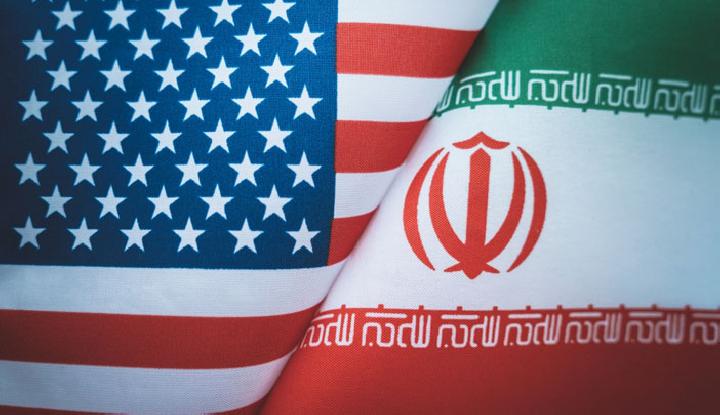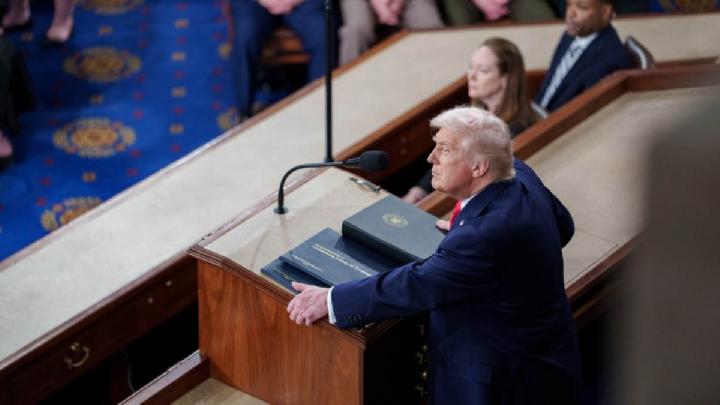
TEMPO.CO, Jakarta - On April 2, 2025, Donald Trump shocked the world by announcing "economic independence" for the U.S., imposing sweeping tariffs on every country in the world. The U.S. Supreme Court has since ruled against the unprecedented move, but the U.S. president seems keen to double down.
DW analyzed trade data on the origin of U.S. imports over the past year to find out: What have Trump's tariffs achieved? How is the rest of the world adjusting to this new economic order? And who, if anyone, is reaping the benefits?
April 2, 2025: White House announces 'Liberation Day' tariffs
Under the "Liberation Day" tariffs, the White House announced that every country — with a few exemptions due to sanctions and pre-existing trade deals — would be subject to a 10 percent baseline tariff on all goods they export to the U.S. Additionally, 85 countries that export more to the US than they import would be subject to higher tariffs of up to 50 percent.
"I don't think people expected the U.S. administration to essentially declare a trade war on the entire world," says Haishi Li, economist at Hong Kong University whose research focuses on how tariffs and sanctions impact global trade.
Chaos broke out immediately, and global stock markets plummeted. While Trump insisted publicly that "big business is not worried about the tariffs," he announced a 90-day pause of all tariffs exceeding the baseline 10 percent rate on April 9.
During this pause, many trading partners such as the European Union, Vietnam, and the United Kingdom hastily negotiated trade deals in the hope of bringing down the announced tariff rates. Negotiations with China remained tumultuous over the next few months, with rounds of tit-for-tat tariffs reaching up to 125 percent.
After multiple last-minute extensions to the 90-day tariff pause, country-specific rates finally came into effect on August 7, 2025.
Early 2025: U.S. importers stockpile in expectation of tariffs
Even before April, it was clear that changes were coming. "Tariffs are going to make us rich as hell," Trump announced upon entering his second term in January 2025.
U.S. companies understood the message: Racing to fill warehouses before costs increased, they dramatically boosted their orders, bringing roughly 20 percent more goods into the country between January and March than the 2022–2024 average — equivalent to a plus of around $184 billion.
Anticipating higher tariffs on gold bullion, for instance, the U.S. imported roughly 50 times its usual volume in early 2025, totaling around $72 billion — mostly from Switzerland, but also from an eclectic mix of new or unusual suppliers, including Uzbekistan, the Philippines, and Zimbabwe.
Big manufacturers across Asia also saw sharp increases, with Taiwan, Vietnam, and India all recording more exports to the U.S. than usual.
April to July 2025: U.S. companies shift to lower-tariff countries
The suspension period implemented on April 9 meant U.S. importers had a three-month window in which to adjust to the new situation.
A study by Haishi Li and colleagues found that, overwhelmingly, companies attempted to shift their supply chains to countries with lower tariff rates. "Imports were like water, flowing from high-tariff countries to low-tariff countries," Li told DW.
And from no other country did U.S. imports shift away more than from China, which faced by far the highest, and most volatile, tariff threats of any. The U.S. imported goods worth $66 billion less from China between April and July 2025 than during the same period in previous years.
Canada, which was separately threatened with tariffs of 25 percent, also saw a significant drop in its exports to the U.S., to the tune of $24 billion. However, the country appears to have successfully compensated for this drop by adjusting its trade with other countries: Canada's overall exports in 2025 were only $1.6 billion lower compared to 2024.
"The countries that benefited most from the tariff threat were the '10 percent countries,' such as Australia and Latin American countries," said Li.
But some high-tariff countries also saw huge import surges from U.S. companies: Vietnam, Thailand, and Taiwan faced some of the steepest "reciprocal tariffs" — 46 percent, 36 percent, and 34 percent respectively — yet the U.S. recorded an additional $34 billion in imports from Taiwan alone between April and July.
"U.S. importers tended to import from countries that were potential substitutes for China," Li said. Many manufacturers in Taiwan and Vietnam already had strong ties with U.S. companies, reinforced during Trump's first-term trade dispute with China, which pushed production and supply chains toward these and other Asian economies.
US citizens bear the brunt of tariff costs
So far, the tariffs have not brought production back to the U.S., says Alex Durante, senior economist at the U.S.-based think tank Tax Foundation, which has tracked the domestic impact of the tariffs. "This past year has been quite bad for manufacturing and employment," he told DW. "In fact, the sectors that are growing tend to be ones relatively insulated from the tariffs because of exemptions like computers and AI-related products."
And while U.S. importers shifted where they bought from, the total value of imports returned to normal soon after the "Liberation Day" announcement on April 2.
One figure that has risen sharply is U.S. customs revenue. In 2025, the U.S. Treasury collected $287 billion in customs duties and related taxes — roughly triple the amount in previous years. Early data suggests 2026 is on track to surpass even that total.
This revenue made up around 5 percent of all taxes collected in the U.S. in 2025. Recent studies show that the higher tariffs have been almost fully paid by U.S. importers, not foreign exporters.
As a result, U.S. consumers have ended up bearing the brunt of the burden. "We estimated that the tariffs have effectively cost each U.S. household around $1,000 in 2025," said Durante. "This is the cumulative effect of businesses having to raise prices, cut investment, cut employment, or reduce wages to adjust to the tariffs."
Uncertainty plagues international exporters
Internationally, the months since August 2025 have been marked by hastily brokered — and quickly unraveled — trade deals, alongside fresh rounds of tariff threats aimed at individual countries or product groups.
Global trade, economist Li says, has become a lot more uncertain: "If you ask academics, U.S. policy makers, anyone, what will happen this year — I don't think anyone knows."
The most recent shock to the precarious new normal of the U.S. tariff landscape came in the form of February's Supreme Court ruling, which struck down the legal basis of Trump's original "Liberation Day" tariffs. With a new 15 percent blanket tariff rate in place, and the U.S. administration seemingly determined to find other ways to levy higher duties again, exporters and importers alike are left guessing what the coming months may bring.
To adapt to this uncertainty, Li says governments may focus on supporting companies to explore new markets outside of the U.S. "If they can diversify their supply chains, it will make them more resilient, which might be a silver lining."
Read: Indonesia Prepares Case to Show Compliance in U.S. Trade Probe
Click here to get the latest news updates from Tempo on Google News