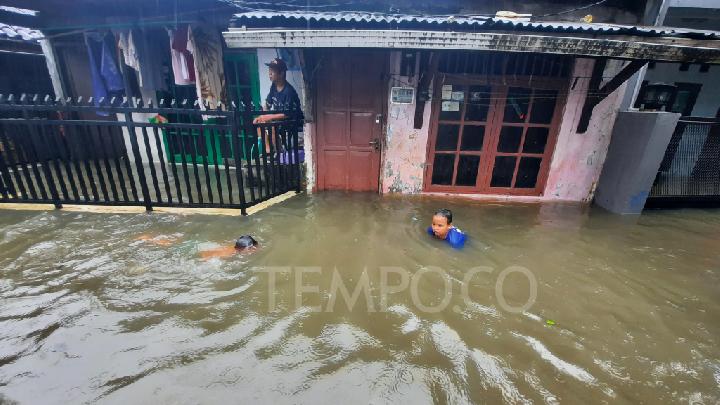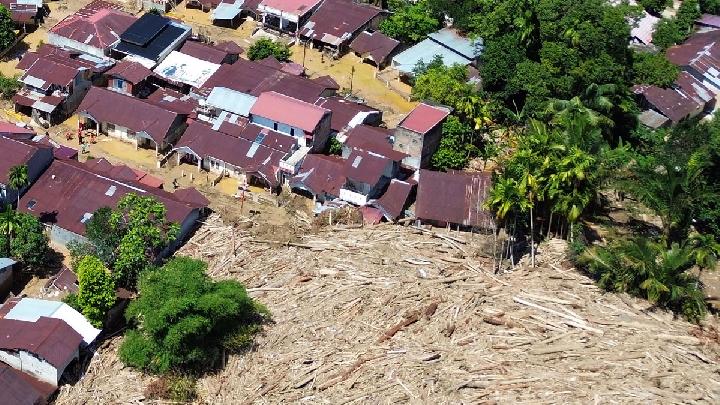
TEMPO.CO, Jakarta - Extreme weather is not the sole reason for the devastation left by flash floods and landslides in Sumatra. Erma Yulihastin, a researcher at the National Research and Innovation Agency (BRIN), said the energy from Cyclone Senyar only contributed about 20 percent to the damage, while the remaining 80 percent was all environment-related.
"It's mainly due to environmental changes," said Erma during the online public discussion "The Risks of Extreme Weather and Extreme Solutions" held by the Civil Society Coalition for Climate Justice (JustCOP) on Thursday, December 18, 2025.
The National Disaster Management Agency (BNPB) recorded at least 1,059 deaths, 192 people still missing, and 147 houses damaged in the disaster that wreaked havoc in Aceh, North Sumatra, and West Sumatra during the tail-end of November.
The number of victims is five times greater than that of the 2024 category 3 Cyclone Serjoa in East Nusa Tenggara.
Erma believed the magnitude of recent disasters is the result of land-use change and spatial planning in Sumatra. Citing a journal published by the American Meteorological Society (Matsui, Lakshmi, Small, 2005), she said land cover affects the movement of storms at sea.
"When land cover is preserved, the cool temperature due to evaporation causes the storm to move away from the land," Erma said. On the contrary, land clearing will make for an open and hot ground, which will pull the cyclones to make landfall.
Sumatra vulnerable to climate change
Sumatra is projected to become the most vulnerable region to climate change in Indonesia over the next 20 years. "Based on 14 models of projections until 2040, especially in North Sumatra and Riau, the region becomes the most vulnerable area to extreme rain and winds in the period from December to January. Therefore, preparations and disaster mitigation must be strengthened," she said.
Farwiza Farhan, Director of the Aceh Forest, Nature and Environment Foundation (HAkA), agreed. Aceh has been losing forests over the past decade. According to her, before 2010 and after the tsunami, Aceh had a spatial planning map that mapped the province, including land sensitivity and population distribution.
"This mapping reveals that land clearing will raise disaster risks, since the environmental carrying capacity has reached its upper limit," she said.
She also referred to the results of a study by Cut Azizah (IPB, 2020), which concluded that the Aceh Tamiang region is extremely vulnerable due to the loss of many watersheds. The study revealed that environmental damage will result in flash floods in 70 percent of villages in Aceh Tamiang, as well as in the East and Southeast Aceh regions.
"This is something that has been known for a long time," said Farwiza.
In North Sumatra, the hardest-hit areas after floods are surrounded by a number of extractive and exploitative industries. Delima Silalahi, a researcher at the Toba Initiative, expressed disappointment with the government's slow disaster response.
Since it has not been declared a national disaster, connecting the affected regions with one another proves to be a challenge. "Clean water in Central Tapanuli and South Tapanuli is still scarce. Many of them are taking refuge on their own on hillsides like Angkola," she said.
Nailul Huda, Director of CELIOS Digital Economy, spoke about the irony of the Sumatra floods. CELIOS's research revealed that mining-dependent villages have greater environmental pollution and disaster impact.
In 2018, one out of two villages dependent on the mining sector was likely to be harder hit by floods compared to villages not dependent on the extractive industry. In these villages, the flood potential is one in four.
Disaster risk is exacerbated by the government budget policies, as disaster management budget only takes up about 0.03 percent of the State Budget. The government is also allotting less and less budget for this sector.
Huda believed the short-term disaster recovery would be challenging, with Aceh and West Sumatra heavily relying on central government transfer funds. "What I am concerned about is Aceh, since it heavily relies on regional transfer funds that will be reduced next year," he said.
He said that the disaster recovery budget of Rp51.82 trillion does not yet cover human development. "With this budget policy, it will take 30 years just to recover Aceh," he said.
"In the end, extreme weather and exploitative industrial activities become the causes of the disaster, but the question is, when the disaster occurs, how ready is the country to protect its people?" he said.
Read: Prabowo Talks Disaster Handling, Defense in Bukittinggi Meeting with Ministers
Click here to get the latest news updates from Tempo on Google News