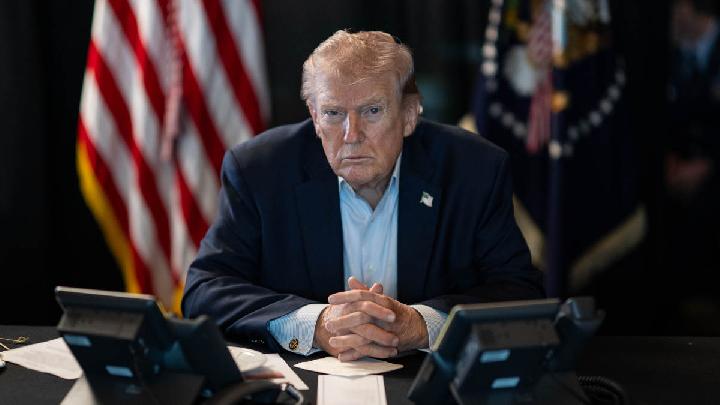
TEMPO.CO, Jakarta - US President Donald Trump has issued a decree classifying fentanyl as a "weapon of mass destruction" — a radical political term for a substance that has been silently killing people in large numbers for decades. "No bomb does what this is doing," Trump announced. He claimed that at least 200,000 to 300,000 people a year were dying as a result of using fentanyl.
The true figure as recorded by the US public health authority, the CDC, is indeed alarming, but it is much lower than this. The CDC reports that more than 76,000 people overdosed on the drug in 2023. In 2024, however, that number had dropped to 48,422. In Europe, the number of deaths remains in the low hundreds.
What makes this medication, designed to relieve extreme pain, so dangerous? And can it really be described as a weapon of mass destruction?
The official meaning of the new categorization
The recategorization by Trump means fentanyl is no longer solely regulated by health and criminal legislation. It is now also deemed to be a national security issue. The intelligence services and the military could, in principle, become more involved: for example, in combating drug cartels, or if someone is suspected of planning to use fentanyl in an attack.
In its 2019 study "Fentanyl as a Chemical Weapon," the Center for the Study of Weapons of Mass Destruction (CSWMD) concluded that there did not appear to be "any basis or need for … officially designating fentanyl compounds as weapons of mass destruction, … at least for the Department of Defense." The CSWMD is located in the Institute for National Strategic Studies, a department of the National Defense University (NDU) in Washington, D.C., which is funded by the US Department of Defense.
However, John P. Caves, the author of the report, also warns that "there is at least a risk that fentanyl compounds could be used as chemical weapons." He recommends that the use of aerosolized agents affecting the nervous system, such as fentanyl, in law enforcement should be clearly prohibited, as it is "inconsistent with the Chemical Weapons Convention." The Department of Defense should also, he writes, "continue to advance its understanding of fentanyl compounds as potential chemical weapons."
Trump's decision a 'political exercise'
Dennis Fitzpatrick, a national security specialist and former assistant US district attorney, has criticized the new categorization. He described it as a "political exercise" for which there is "no practical reason," because: "We already have statutes on the books that are tested, that prosecutors and agents are accustomed to working with, and they're very clear, and they accomplish the same goals."
National Public Radio (NPR) spoke to numerous experts in public health and tackling addiction, who stressed that it was extremely technically difficult to deploy fentanyl like a conventional weapon of mass destruction in a potential terrorist attack. The vast majority of fentanyl deaths occur in users of adulterated street drugs, they said, not as the result of an attack.
Experts in the field say the new categorization will not reduce the availability of fentanyl on the street or the number of overdose deaths. Rather, they see it as further militarization of the "war on drugs." Meanwhile, prevention, treatment, and social measures remain underfunded and still receive far too little attention.
The move also makes international cooperation more difficult — particularly with China, with regard to precursor substances, because it gives the impression that Beijing is being indirectly accused of supporting the manufacture of "weapons of mass destruction."
People in the security community who support the move, as well as victim organizations such as Families Against Fentanyl, argue that the number of deaths and the economic damage done equate to a "weapon of mass destruction in slow motion." They say this justifies deploying the full apparatus of the intelligence services, the military, and international pressure.
Fentanyl explained: provenance, medical uses, and risks
Fentanyl is a synthetic opioid. It is a strong pain medication used primarily in anesthesia and in end-of-life care for patients with terminal cancer.
It is considerably more potent than classic opioids, like morphine or oxycodone. Even very small quantities are sufficient to block severe pain. Fentanyl was initially developed as a highly effective, easily controllable anesthetic. It is indispensable for medical care, where the dosage and application are strictly monitored.
How fentanyl works — just a few milligrams can kill
Fentanyl binds to opioid receptors in the central nervous system and suppresses the sensation of pain, often triggering a strong sense of euphoria and relaxation. It is precisely this combination that makes it attractive as a recreational drug and highly dangerous. Just a few milligrams can reduce the respiratory drive to such an extent that an affected person will breathe only very shallowly or stop breathing altogether.
The consequences are oxygen deficiency, unconsciousness, coma, and, if the worst comes to the worst, respiratory arrest, which is very quickly fatal. Fentanyl is also highly addictive, and the addict's tolerance level rises fast, prompting them to increase the dose, and the safety margin between getting high and dying is minimal.
Tablets, patches, and dangerous mixtures
In hospitals, fentanyl is usually given by intravenous injection or in patches that administer it through the skin on continuous slow release. On the black market, it is mostly available as a powder or as manufactured pills. It is also increasingly common to find it in forms that can be smoked or inhaled.
The problem is that illegal manufacturers do not dose precisely. They also mix fentanyl with other drugs, such as cocaine or heroin, and consumers cannot know how strong the product actually is.
As little as two milligrams of fentanyl can be fatal. All it takes is a single badly mixed plaster or one drag too many. Even used fentanyl patches can still contain enough of the active ingredient to put a person's life in danger if they are misused.
Global supply chains: China, Latin America and the US
Fentanyl is a wholly synthetic substance created in chemical laboratories. It was circulating as an illegal recreational drug as early as the 1970s, and uncontrolled production soared from the 1980s onward.
Today, precursors and chemical components from China are important components of the illegal supply chain. They are processed into fentanyl powder and pills, primarily in Central and South America. The drug is then smuggled from here to Europe and, above all, to the United States.
In 2022, the US Drug Enforcement Administration (DEA) confiscated more than 50.6 million counterfeit pills containing fentanyl, and around 4.5 tonnes of fentanyl powder. It is estimated that this quantity represented more than 379 million potentially fatal doses. According to Anne Milgram, head of the DEA at the time, that is "enough … to kill every American."
Read: Indonesian Drug Kingpin Dewi Astutik Arrested in Cambodia
Click here to get the latest news updates from Tempo on Google News