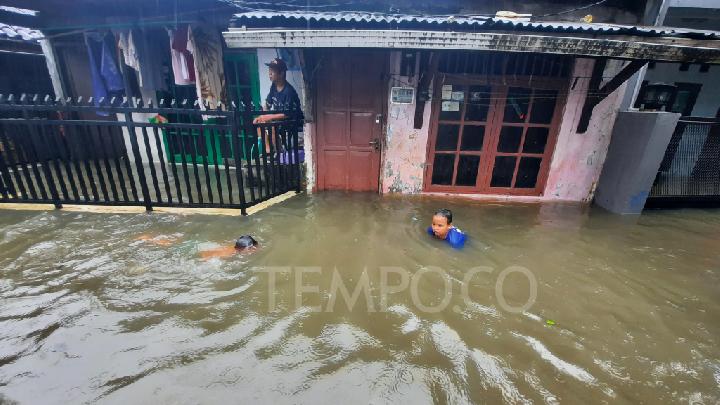
TEMPO.CO, Jakarta - The Indonesian government is building temporary and permanent housing for residents affected by floods and landslides in West Sumatra, North Sumatra, and Aceh. But this undertaking raises a crucial question: how to ensure these houses are built in disaster-safe locations.
Dwikorita Karnawati, a professor of geological and environmental engineering at Gadjah Mada University (UGM), said determining the location is far more important than the speed of construction.
"To ensure safety, evaluation is a necessity," said Dwikorita when contacted on Friday, December 19, 2025.
Flash Floods Are Recurring in Nature
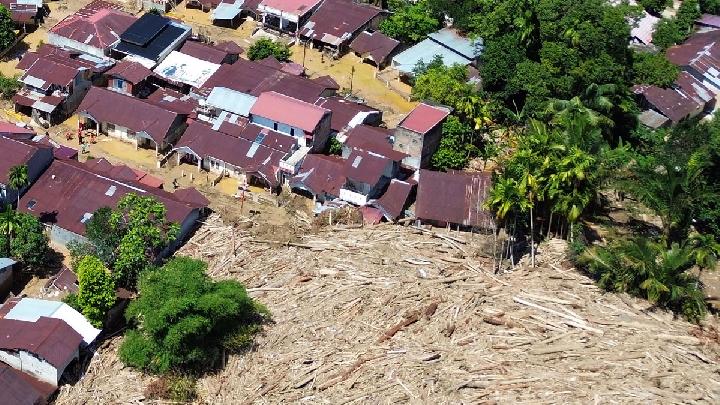
According to the former head of BMKG, the flash floods in Sumatra are not isolated incidents but a series of events that begin with landslides upstream and culminate in a major disaster downstream.
Scientific studies are necessary to discern the safe housing zones. Satellite image analysis shows various landslide points and land clearing expansion, which produces a large amount of sediment.
These sediments often form natural dams in rivers, which burst during a torrential downpour and set off a mixture of water and solid materials at high speed downstream.
Flash floods are recurring risks, she said, citing Dasbahorok, North Sumatra, which had similar incidents in 2003 and years before that. Hence, permanent housing designed to last for decades are not ideally located over the flash flood pathways.
Building temporary housing in these locations is also risky, since the sediments upstream could trigger subsequent floods. "If heavy rain occurs, the sirens blare, and people can evacuate," said Dwikorita.
Another issue that belies post-disaster housing construction is the government's willingness to take daring relocation measures. Rushing into it would often lead to the government opting for old, risky locations. But the pattern of disasters shows how such an approach would only prolong this cycle of vulnerability.
Lack of Settlement Planning
Mohammad Jehansyah Siregar, a housing observer from the Bandung Institute of Technology (ITB), believes that the key issue is a lack of planning. In hilly and mountainous areas, the no-go zones must be determined before development begins.
Jehansyah emphasized the basic principle of settlement planning: built on flat, stable land, far from protected sites, and watersheds. But many flat locations are actually sediment deposits that are prone to disasters. "The most important thing is to avoid slopes," he said on Friday.
Regardless of how strong a building is, the location remains the determining factor for safety. Settlements surrounding watersheds are almost certain to be damaged when flash floods occur. The government must ensure basic services for residents to avoid pushing them to settle in vulnerable grounds.
Jehansyah warned that the government's focus on housing construction should not obscure the root of the disaster problem. According to him, relocation and housing construction will only be effective if accompanied by proper state control upstream. Otherwise, it will be wash and repeat with disaster risks.
President Prabowo Calls for Immediate Housing Construction
The directive to accelerate construction comes directly from President Prabowo Subianto. He conveyed this order after summoning several ministers to his private residence in Hambalang, Bogor, on Sunday, December 14, 2025.
"The President asked for the immediate construction of housing units," said Cabinet Secretary Teddy Indra Wijaya, referring to temporary and permanent housing units in disaster-hit Sumatra.
Finance Minister Purbaya Yudhi Sadewa ensured the budget availability. He said BNPB proposed an additional budget of Rp1.6 trillion for the construction, in addition to the Rp1.3 trillion of funding earmarked next year.
The Ministry of Housing and Settlements followed up on this instruction with plans to construct thousands of permanent houses. Minister Maruarar Sirait stated that the government will build permanent housing in West Sumatra, North Sumatra, and Aceh.
"As of today, we are ready to build 2,603 housing units," said Maruarar on Wednesday, December 17, 2025.
Maruarar mentioned that the construction of permanent housing is targeted to commence this December. The government deems this a priority to relieve residents from having to stay in shelters for an extended time.
Prabowo personally inspected the housing construction site. When visiting the shelter for disaster-hit residents in Agam Regency, West Sumatra, on Thursday, December 18, 2025, he said the temporary housing construction has kicked off, and is projected to finish within a month.
Subsequently, the Indonesian government will move to build permanent housing with a relatively larger size of about 70-square-meter each. The quality, he mentioned, is "good enough" for long-term residence.
Hendrik Yaputra and Dian Rahma Fika contributed to the writing of this article
Read: Govt Uses Flood-Drifted Wood to Build Temporary Housing in Sumatra
Click here to get the latest news updates from Tempo on Google News