
February 23, 2026 | 04:16 pm
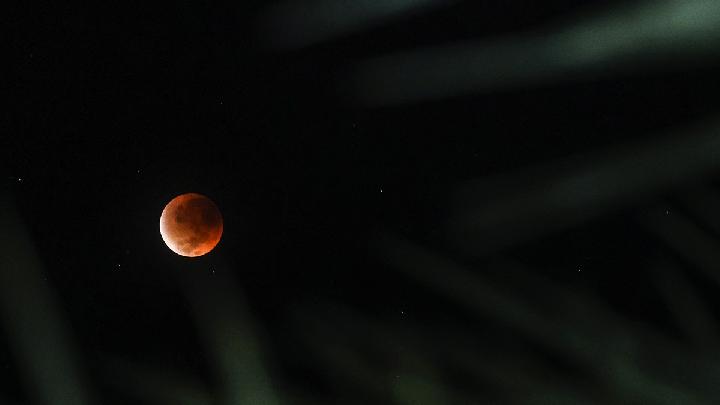
TEMPO.CO, Jakarta - The night sky is preparing for a dramatic transformation this coming March. For a few brief, mesmerizing hours, the familiar silver glow of the full Moon will bleed into a deep haunting crimson. This rare alignment, known as a Worm Blood Moon, creates a celestial masterpiece that turns the night sky into a breathtaking view.
If you are a skywatcher or an amateur astronomer looking to witness this celestial spectacle, preparation is the key. From its unique nickname to the precise moment the shadow falls, here is everything you need to know about the upcoming lunar event according to NASA and Almanac.
How Does a Blood Moon Occur?
A Blood Moon occurs because the Earth positions itself directly between the Sun and the Moon. This occurrence often raises questions about how the Moon remains visible while being covered in the Earth’s shadow; the answer lies in a scientific phenomenon called Rayleigh Scattering.
This effect occurs when the Earth’s atmosphere acts as a filter, scattering shorter blue wavelengths while allowing longer red wavelengths to pass through. These red rays are then refracted around the edges of our planet and projected onto the lunar surface, giving the Moon its haunting glow.
What is the Connection to the Worm Moon?
Usually, the Worm Moon appears as a dazzling silver orb, serving as a sign of an early spring. Its name, popularized by The Old Farmer’s Almanac, comes from a mix of Native American, Colonial American, and European traditions. It specifically refers to earthworms that begin to surface as the soil warms and softens. However, this rare transformation into a Worm Blood Moon represents a stunning fusion of two celestial events.
It occurs when the Moon reaches its full phase while at the same time, passing through the deepest part of the Earth’s shadow. This alignment shifts its color from a bright silver to a dark rusty red, creating a hauntingly beautiful spectacle.
Eclipse Phases and Timeline
To catch this celestial masterpiece, you must know exactly when to look up. On March 3, 2026, the eclipse will go through several phases.
Here is the timeline of the event:
Penumbral eclipse (12:44 PST, 3:44 EST, 8:44 UTC): The Moon moves to Earth’s penumbra, the outer part of the shadow. At this stage the Moon starts to dim, though the visual effect is quite subtle.
Partial eclipse (1:50 PST, 4:50 EST, 9:50 UTC): The transition becomes much more noticeable as the Moon moves into the Earth’s umbra. It will appear as if a “bite” is being taken out of the lunar disk, with the shadowed area appearing very dark.
Totality (3:04 PST, 6:04 EST, 11:04 UTC): This stage marks the start of the actual “Blood Moon” phase. During this period, the lunar surface will appear coppery red.
Totality ends (4:03 PST, 7:03 EST, 12:03 UTC): As the Moon begins to exit the Earth’s umbra, the deep red color starts to fade. It will look as if the dark “bite” is being taken out of the opposite side.
Partial eclipse ends (5:17 PST, 8:17 EST, 13:17 UTC): The Moon returns to Earth’s penumbra, the dimming effect remains visible but subtle.
Penumbral eclipse ends (6:23 PST, 9:23 EST, 14:23 UTC): This final stage marks the official end of the eclipse.
Best Location to Watch the Blood Moon
The visibility of the eclipse depends on your specific geographic location and whether the Moon is above the horizon during the event. Because the process occurs over several hours, different parts of the world will experience different phases of the transformation.
Here is the list of regions where the eclipse will be visible:
Eastern Asia and Australia: Observers will see the total lunar eclipse in the evening.
Pacific Ocean: The eclipse will be visible throughout the night.
North, Central America, and Western South America: The event will be visible in the early morning.
Central Asia: Only a partial lunar eclipse will be visible in the area.
Europe and Africa: No part of the eclipse will be visible.
Observing a lunar eclipse does not require any special equipment, as it is safe to view with the naked eye as long as you have a clear line of sight to the moon. For the best results, seek out a dark environment away from bright lights. Although optional, using binoculars or a telescope can further enhance your view of the lunar surface and its color shifts.
Muhammad Raymizzaad Noor (Intern)
Read: List of 2026 Lunar Events: 13 Full Moons, Supermoons, and Eclipses
Click here to get the latest news updates from Tempo on Google News
Total Lunar Eclipse Expected to Turn Moon Red on Monday, Sept. 8
3 September 2025

According to the Meteorology, Climatology, and Geophysics Agency (BMKG), the total lunar eclipse is likely to begin at 12:37 a.m. on Monday.
Catch the Blood Moon in Australia, 2025 Lunar Eclipse on 7th and 8th September
26 Agustus 2025
Brace yourself, Australia! 2025's final blood moon will paint the skies on September 7th and 8th. Here's a guide to catch the rare celestial event.
Blood Moon Is Coming on September 7; Here's When and Where to See Worldwide
15 Agustus 2025
On September 7, a rare blood moon will be visible to over 7 billion people worldwide, with totality expected to span 82 minutes. Learn more here.
Total Lunar Eclipse to Grace Mid-Ramadan Skies on March 13-14
26 Februari 2025

This lunar eclipse can be observed in various regions around the world, especially in North and South America, which will provide the best view.
Jakartans Able to Observe Total Lunar Eclipse Blood Moon on Tuesday
8 November 2022

Tuesday's total lunar eclipse or blood moon will be observable starting at 17:43 Western Indonesia Time (WIB).