
TEMPO.CO, Jakarta - Space debris once again caused a stir among residents in several regions of Lampung, Indonesia, after a glowing object was seen streaking across the sky on Saturday night, April 4, 2026.
The bright bluish flash with a long tail appeared to cut through the sky for several seconds before disappearing.
Space debris has also been observed across several regions in Indonesia, such as in 2022 over the Sanggau area of West Kalimantan, and on January 4, 2021, in Teluk Kramat, West Kotawaringin, Central Kalimantan.
So, what exactly is space debris, and what causes it?
Here is an explanation summarized from various sources, including science.nasa.gov and information from researchers at BRIN.
What is Space Debris
Space debris, also called orbital debris, refers to all human-made objects in outer space that are no longer functional. According to NASA and ESA, these objects include inactive satellites, spent rocket stages, and small fragments from collisions or peeling paint.
The viral celestial object passing through the skies of Lampung on April 4, 2026. Antara/HO-Screenshot
These objects either remain in orbit around Earth or are entering the atmosphere. Most space debris comes from rocket launch materials or decommissioned satellites.
Most of this debris is in Low Earth Orbit (LEO), up to about 2,000 kilometers above the Earth’s surface. Some debris occupies higher orbits, such as geostationary orbits, approximately 35,786 kilometers above the equator.
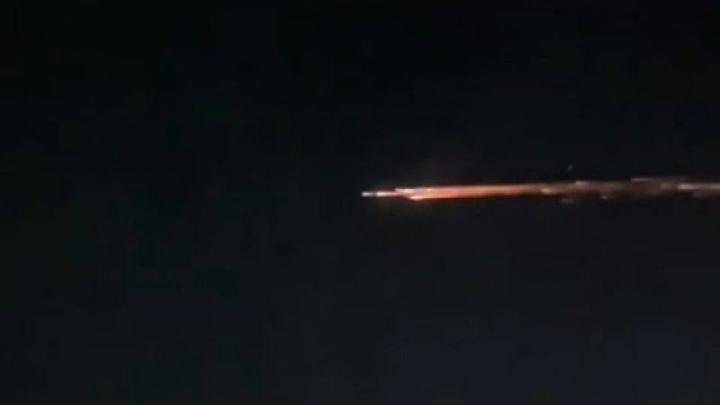 The viral celestial object passing through the skies of Lampung, April 4, 2026. Antara/HO-Screenshot
Causes of the Increase in Space Debris
The amount of space debris continues to grow as human activity in space intensifies. A primary factor is the rising number of satellite launches. Internet satellite constellations, such as SpaceX’s Starlink, now account for about half of all active satellites in orbit, with thousands more planned.
In addition, many satellites that have reached the end of their operational life remain in orbit, becoming debris. It is estimated that thousands of inactive satellites still circle the Earth.
Anti-satellite weapon tests by several countries also contribute to the increase. Destroying satellites produces numerous small, uncontrollable fragments that remain in orbit.
Other factors include fragmentation caused by collisions, explosions, or material degradation in space. A single destroyed object can produce dozens or even hundreds of new fragments, further increasing the density of debris in orbit.
How Space Debris Descends to Earth
Professor Thomas Djamaluddin, an astronomer at the National Research and Innovation Agency (BRIN), explained that the main reason debris falls to Earth is air resistance in low orbit. Remnants of rockets or inactive satellites gradually slow down due to interactions with the atmosphere, causing their altitude to decrease over time.
The lower the orbit, the stronger the atmospheric drag, until the object can no longer maintain its orbit and begins to descend toward Earth.
During re-entry, space debris travels at extremely high speeds. Friction with air particles generates intense heat, causing most objects to burn up and disintegrate. This is observed from Earth as a bright streak across the sky.
According to reports, most space debris completely burns before reaching the surface. However, larger objects or those made of heat-resistant materials may survive partially and fall to Earth.
The long-tailed bluish light seen in Lampung is part of this re-entry process, which generally lasts only a few seconds before the object disintegrates or disappears.
Read: Two Comets May Be Visible in Indonesia This April
Click here to get the latest news updates from Tempo on Google News